
Surface Processing
Select the board around
the actual process.
Thin MDF manufacturer · Wen'an, Hebei, China
MDF selection for lamination starts with the buyer's surface material, adhesive, equipment and finished component. A smooth-sanded board may be considered for several decorative processes, but no MDF specification should be treated as universally compatible without evaluation on the buyer's actual line.
Why MDF surface quality matters for lamination
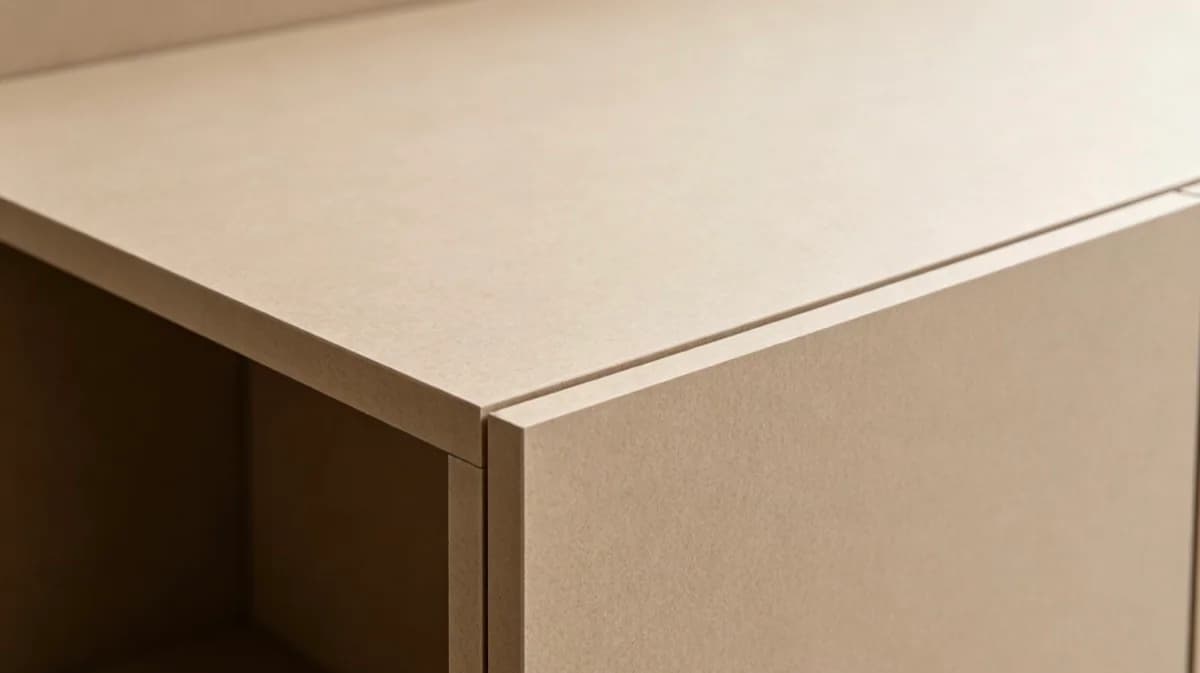
The laminated surface can reflect conditions in the base panel. Buyers should review surface smoothness, sanding uniformity, visible fibres, pits, scratches, contamination and local damage before approving material for production.
Thickness consistency, handling damage and storage conditions can also affect feeding, stacking, pressing and assembly. Raw boards should be protected from contamination and uncontrolled exposure while awaiting downstream processing.
Choosing MDF for different lamination processes
Buyers searching for laminate for MDF or laminate for MDF board are usually selecting two connected specifications: the decorative surface material and the MDF substrate beneath it. Both must be evaluated together against the intended production process.
PET film, PVC film, decorative paper, melamine-related processing, veneer and other decorative surface materials represent different buyer evaluation scenarios. Each process can involve its own surface preparation, adhesive, equipment and finished-product requirements.
These materials are commonly discussed in lamination sourcing, but this guide does not state that Xinyao MDF is automatically compatible with any specific film, paper, veneer, coating or glue system. Buyers should provide the actual materials and process for review and validation.
Thin MDF for lamination
Xinyao's published product range covers thin MDF from approximately 0.8 mm to 6 mm, including several nominal thickness options within that range. The product information identifies raw, smooth-sanded surfaces for subsequent processing review.
The appropriate thickness depends on the component construction, support conditions, handling method and downstream line. Buyers should not assume that one thin MDF thickness is interchangeable with another or suitable for every lamination process.
Surface smoothness and sanding
Surface review should examine both the overall sanding condition and local defects. Check for uneven sanding, raised or loose surface fibres, pits, scratches, dust, oil or other contamination, impact marks and damage near board edges.
No numerical roughness value is published in Xinyao's current buyer documents. If a process requires a defined surface-measurement method or acceptance limit, include it in the specification and sample-approval process.
Thickness consistency
Thickness variation may affect line feeding, lamination pressure distribution, stacked components and final assembly. The required acceptance limit should be defined according to the nominal thickness and the buyer's equipment rather than assumed from a general product description.
Density and board structure
Density and thickness are separate specification variables. Density selection should be reviewed with the component, machining, surface process and handling requirements; one density should not be assumed suitable for every laminated product.
Trial lamination before bulk orders
Buyers using a particular adhesive, film, paper, veneer, coating, press, temperature setting or production line should evaluate the selected MDF with the actual process before bulk production. A sample that has passed the buyer's own processing review provides a clearer reference for the order specification.
Record the approved board thickness, dimensions, density requirement, surface condition, lamination material, process and acceptance observations. A trial does not replace production inspection, but it helps separate board specification from process compatibility.
What buyers should tell the MDF supplier
A complete inquiry allows the factory to review the requested board and avoids treating “MDF for lamination” as a complete specification.
Nominal thickness and board dimensions
Density requirement
Laminating or decorative surface material
Adhesive and process information where relevant
Finished application or component
Order quantity and destination port
Packaging and handling requirements
Sample or trial-production requirement
Quality inspection and production review
Xinyao's existing quality information covers production monitoring, finished-board thickness and density checks, surface inspection and final review before shipment. Buyers requiring additional surface or process-related inspection should define it before production.
Request samples or quotation
Send the thickness, size, density requirement, lamination material, application, quantity, destination port, packaging and sample requirements for factory review. Compatibility with the buyer's actual process remains subject to sample or production-line validation.
Lamination MDF Specification Review
Send your material and process details
for factory review.
Provide thickness, size, density, lamination material, application, quantity and destination port.
Request Samples & Quotation